Why not just use JavaScript?
It is the first question anyone asks, and it is a fair one. Nilo compiles to JavaScript. Anything it can do, JavaScript can do. So why not write that in the first place?
Because JavaScript does not know what I am doing.
It has no idea what a point is, or a colour, or a sheet of paper, or a token hash. So every piece begins with machinery: a random generator seeded from the hash, a way to hold a point, a way to mix two colours. None of that is the art. All of it has to be right, and when it is wrong nothing tells me. I get a piece that looks fine and comes out different the next time.
It is also untyped, which I have never liked. I can hand a width to something expecting a colour and find out only by looking.
And small JavaScript is unreadable JavaScript. My work goes on chain, where size matters. To get the size down by hand I would have to write in a way I could not read a month later.
Nilo splits those apart. The file I write is short and plain, in the words of the work. The file that ships is tiny, and I never look at it.
A whole piece
plate(1920, 2400)
random layout

background(#f4f1ea)
for i in 0 ..< 200 {
  let p = vec(layout.float(0 ..< 1920), layout.float(0 ..< 2400))
  circle(p, layout.float(4 ..< 40))
  fill(#1b1b1f)
}
That is everything. Eight lines, and every one of them is about the art.
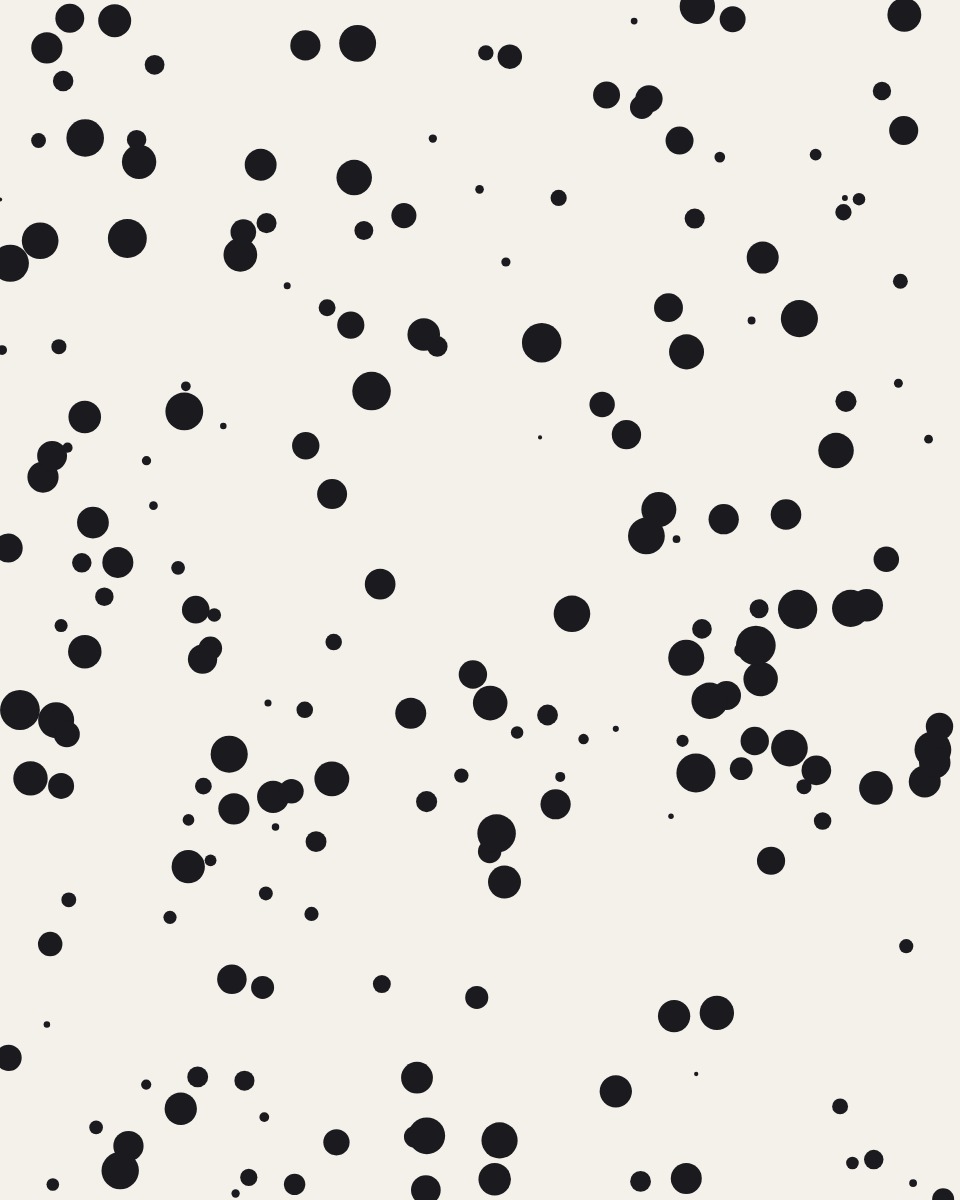
It is not much of a piece. The point is what is missing from the file. There is no generator, no hash parsing,
no canvas setup. random layout gives me a source of random numbers that comes from the token hash, so the same
token always makes the same piece. If I forget and reach for an unseeded random, the compiler refuses.
It ships as 348 bytes.
What it costs
I should be fair about the other side.
- Nobody else knows this language. When I am stuck there is nothing to search for, only one reference page.
- My editor does not understand it yet. No colours, no hints.
- If something is missing from the language I cannot just write it. It has to be built.
For now I think the trade is worth it. I would rather wait for a word that fits than write forty lines around the lack of it.